

A Random Walk Down Wall Street by Burton G. Malkiel is one of the most influential investing books ever written.
Its central claim is deceptively simple:
Markets are far more efficient than most investors are willing to admit — and trying to outsmart them is usually a losing game.
Like The Simple Path to Wealth, this book is not about clever tactics or financial wizardry.
It is about accepting how markets work and aligning your behavior with that reality.
If The Four Pillars of Investing explains why investors fail, A Random Walk Down Wall Street explains why beating the market is so hard in the first place.
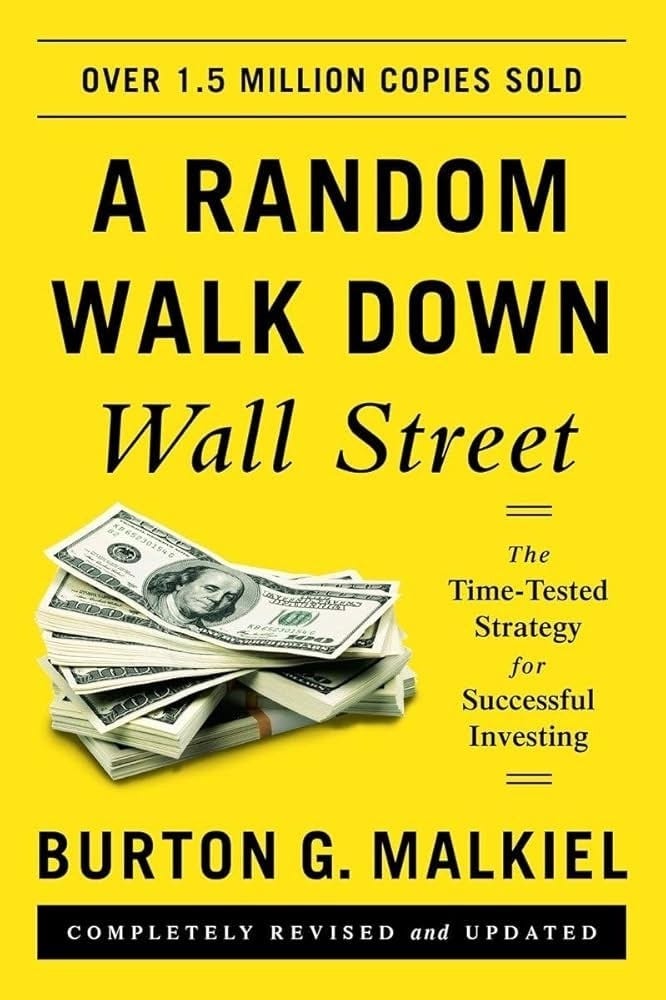
What the Book Is Really About
At its core, the book argues that:
Stock prices incorporate available information quickly
Short-term price movements are largely unpredictable
Professional managers rarely outperform consistently after costs
The “random walk” metaphor means that price changes resemble random steps, not because markets are irrational, but because new information is unpredictable.
The Efficient Market Hypothesis (Without the Jargon)
Malkiel introduces the Efficient Market Hypothesis (EMH) in practical terms.
Key implications:
Past prices do not reliably predict future prices
Most technical analysis adds little value
Public information is already reflected in prices
Outperformance is usually luck, not skill
This doesn’t mean markets are perfectly rational — it means they are good enough to make forecasting extremely difficult.
Why Active Investing Fails Most of the Time
The book dismantles the case for active investing piece by piece.
Malkiel shows that:
Mutual funds underperform their benchmarks over time
Survivorship bias hides failures
High turnover increases costs and taxes
Even talented managers experience long periods of underperformance
The key insight is not that active investing never works — but that you cannot reliably identify winners in advance.
Bubbles, Speculation, and Human Nature
One of the strengths of the book is its treatment of bubbles.
Malkiel reviews:
The South Sea Bubble
The 1929 crash
The Nifty Fifty
The dot-com boom
Each episode follows the same pattern:
A compelling story
Rapid price appreciation
Rationalizations for extreme valuations
Collapse
Markets may be efficient, but investors are still human — and narratives remain powerful.
The Practical Alternative: Index Investing
The book’s most actionable message is its endorsement of index funds.
Malkiel argues that:
Broad market exposure captures market returns
Low costs preserve compounding
Diversification reduces uncompensated risk
Simplicity increases discipline
Instead of trying to find the next winner, the investor should own the entire market.
Asset Allocation Still Matters
Importantly, Malkiel does not advocate a one-size-fits-all portfolio.
He emphasizes:
Risk tolerance
Time horizon
Human capital
The role of bonds in reducing volatility
While stock selection may be futile, portfolio construction is not.
How This Book Changes the Way You Invest
After reading A Random Walk Down Wall Street, several conclusions become unavoidable:
Markets do not reward effort, only exposure
Costs are one of the few controllable variables
Diversification is the closest thing to a free lunch
Predicting prices is far harder than predicting narratives
Discipline beats conviction
This book shifts the investor’s focus from prediction to process.
Who This Book Is For
This book is ideal for investors who:
Are tempted by stock picking or market timing
Believe skill guarantees outperformance
Want evidence over anecdotes
Prefer systems over opinions
It is especially valuable for those early in their investing journey — before bad habits form.
Final Takeaway
A Random Walk Down Wall Street delivers a humbling conclusion:
You do not need to be smarter than the market.
You need to stop fighting it.
Like The Simple Path to Wealth, this book ultimately argues that acceptance is an advantage. By accepting market efficiency, randomness, and your own limitations, you dramatically increase your odds of long-term success.
It is not a book that promises excitement.
It promises survival — and that is far more valuable.