

Life is full of choices.
Most are small and forgettable. A few are big decisions — ones that shape the trajectory of wealth, relationships, and career.
Big decisions are not about luck or charisma.
They are about systems, frameworks, and optionality. Making them deliberately increases the probability of long-term success and reduces regret.
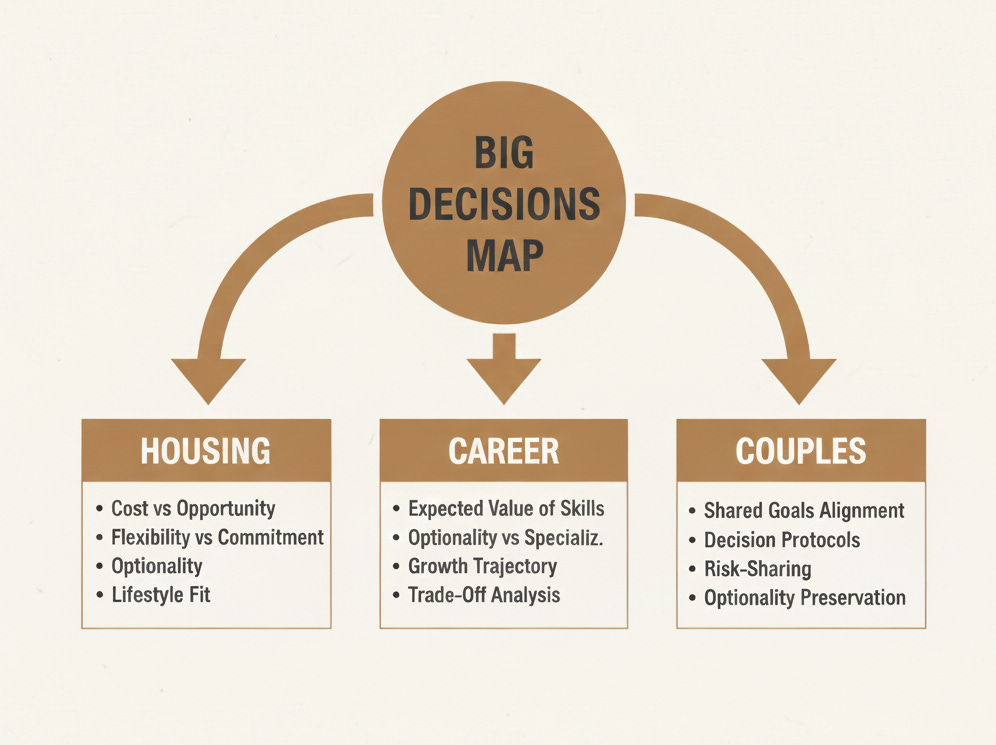
This post outlines frameworks for three of the most impactful categories: housing, career/human capital, and couple/relationship decisions.
1. Housing: More Than a Roof
Buying a home or choosing a place to live is one of the largest financial decisions most people make. Treat it as a strategic, not emotional, choice.
Framework for Housing Decisions
Cost vs Opportunity:
Compare total housing cost (mortgage/rent, maintenance, taxes) with potential investment opportunity cost.Flexibility vs Commitment:
Buying locks you in; renting offers mobility. How much does flexibility matter for your career or personal goals?Optionality:
Can the property be rented if circumstances change? Is it liquid enough if you need to move quickly?Lifestyle Fit:
Consider commute, amenities, social network, and long-term satisfaction.
Rule of thumb: Never let emotions outweigh structural reasoning. Treat your housing choice like a capital allocation decision.
2. Career & Human Capital: Treat Yourself Like an Asset
Your career is the single largest source of wealth over a lifetime. Yet it is often managed haphazardly, like a series of reactive moves.
Career Decision Framework
Expected Value of Skills:
Assess the market value of skills you are building, not just current salary.Optionality vs Specialization:
Deep specialization can pay off in high demand, but reduces flexibility. Broad skills create exit options and mobility.Growth Trajectory:
Map out possible career ladders, lateral moves, and potential bottlenecks.Trade-Off Analysis:
Evaluate trade-offs between money, autonomy, learning, and stress. Decisions are rarely all-positive.
Rule of thumb: Invest in yourself as you would a portfolio. Diversify skills, monitor returns (career progress), and rebalance when necessary.
3. Couples & Relationships: Coordination Matters
Financial and life decisions rarely happen in isolation. For those in long-term relationships, alignment is crucial.
Framework for Couple Decisions
Shared Goals Alignment:
Map long-term goals: housing, children, location, career sacrifices. Misalignment creates latent friction.Decision Protocols:
Agree in advance how to make major choices: who has final say, how to resolve conflicts, which decisions need joint discussion.Risk-Sharing:
Pool or coordinate resources efficiently without losing individual autonomy.Optionality Preservation:
Avoid commitments that prevent either partner from pursuing essential career or personal opportunities.
Rule of thumb: Treat the couple as a dual portfolio — coordination improves returns; misalignment creates structural risk.
General Principles for Big Decisions
Across categories, several meta-principles apply:
Frame the decision structurally: convert qualitative feelings into quantitative or at least structured trade-offs.
Preserve optionality: always ask, “What happens if I’m wrong?”
Use pre-defined criteria: avoid snap emotional decisions during stress.
Accept uncertainty: no framework removes risk; it only clarifies consequences.
Iterate: Big decisions often allow adjustments. Build in checkpoints to reevaluate.
Why a Framework Matters
Big decisions share a common pattern:
They involve high stakes
They are irreversible or costly to reverse
They trigger strong emotions
Without a structured framework, emotional impulses dominate, opportunity cost is ignored, and optionality is lost.
With a framework, even wrong decisions are manageable. You minimize regret, preserve resources, and create room for course correction.
Final Thought
Big decisions are inevitable.
What separates successful outcomes from catastrophic mistakes is how the decision is made, not luck.
Treat housing like capital allocation.
Treat your career like a long-term investment portfolio.
Treat relationships like coordinated risk-sharing.
Frameworks turn big decisions from lotteries into manageable systems — and that is where true leverage in life resides.