

Cryptocurrencies — and Bitcoin in particular — have become one of the most debated topics in finance over the past decade.
Some call crypto the future of money; others dismiss it as speculation. Meanwhile, traditional equity markets like the S&P 500 have a century‑long performance record supported by real economic activity.
So how should investors think about Bitcoin relative to stocks? Is it a diversification tool, a risk asset, or something else entirely?
In this post, we’ll break down:
what Bitcoin is and how it differs from equities,
how its risk and correlation with stocks have evolved,
and how (or whether) it can fit into an investment portfolio.
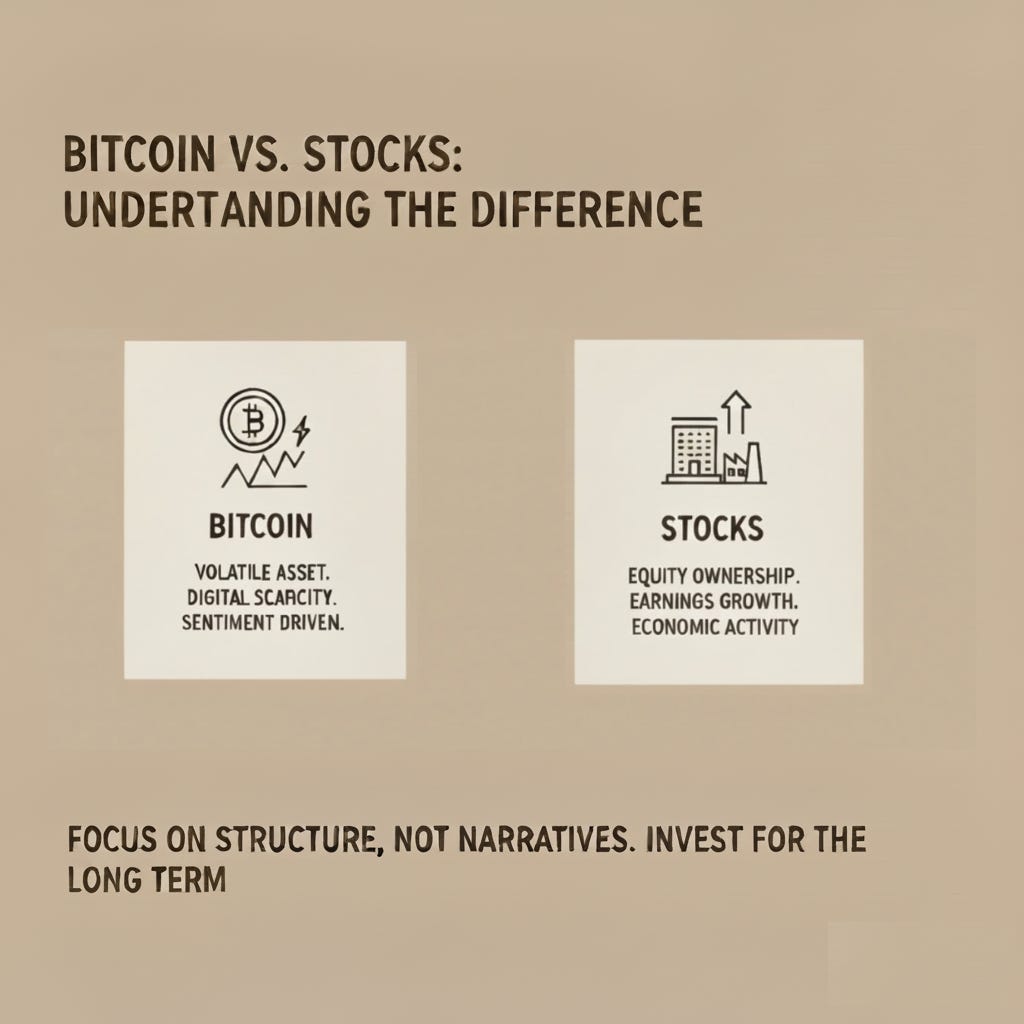
1. Bitcoin Is Not a Stock — Different Origin, Different Drivers
Bitcoin was created in 2008 as a decentralized digital money — peer‑to‑peer and free of central authorities — and became tradable on markets shortly thereafter. Its early promise was to be a new form of payment protocol. Over time, its narrative shifted toward digital gold or a store of value independent of governments and traditional finance.
Equities, by contrast, represent ownership in productive businesses. Stocks generate value through earnings, dividends, and economic growth. Bitcoin doesn’t produce cash flows; its price is driven by supply/demand dynamics, adoption expectations, and sentiment.
This basic structural difference means that risk and return drivers for crypto and equities are fundamentally distinct.
2. Risk Profile: Bitcoin’s Volatility vs Stocks
One of the most striking differences is volatility.
Looking at historical data:
Bitcoin’s volatility and drawdowns have been much higher than equity indices.
Where broad stocks like the S&P 500 may have drawdowns below −20% in typical bear periods, Bitcoin has experienced drawdowns well above −80% in its history.
In practical terms, this means:
Stocks historically recover losses with relatively moderate gains (e.g., to recover −20% might require ~25% gain).
Bitcoin’s large drawdowns can require returns of many multiples just to break even.
Volatility and drawdowns aren’t bad in themselves, but they matter for portfolio behavior — especially for risk tolerance, drawdown tolerance, and the ability to stay invested under stress.
3. Correlation With the Stock Market Has Increased
In the early years — before 2020 — Bitcoin’s correlation with the stock market was close to zero, which meant it sometimes moved independently of equities.
However, as institutional adoption has grown and Bitcoin products like spot Bitcoin ETFs became widely available, its price behavior has become more aligned with traditional risk assets. This means:
Bitcoin now tends to rise in risk‑on environments and fall in risk‑off sell‑offs.
Recent research supports this shift: after the approval of Bitcoin ETFs and greater institutional participation, Bitcoin’s correlation with the S&P 500 has increased, making it behave more like a mainstream risk asset than an isolated miracle.
This trend has important implications:
It weakens the case for Bitcoin as a pure diversifier.
It suggests Bitcoin reacts to macroeconomic sentiment in ways similar to equities.
4. Diversification: Real or Illusion?
Diversification is valuable only if assets behave differently when risks materialize.
Historically, Bitcoin’s low correlation with stocks did create genuine diversification benefits. But in recent years, as the two have become more aligned, the diversification benefit has weakened.
Moreover, adding Bitcoin to an equity portfolio often increases overall portfolio risk, even with small weightings, because its volatility is so high relative to stocks.
For example:
A small allocation to Bitcoin (e.g., 1–5%) does slightly raise return potential but also increases portfolio volatility and drawdown risk.
This doesn’t automatically rule out a place for crypto in portfolios, but it frames expectations realistically: Bitcoin is not a low‑risk diversifier — it is a high‑risk, high‑volatility belt added to a portfolio that can amplify swings.
5. Crypto’s Evolving Role: Risk Asset, Hedge, or Speculative Bet?
Over time, the narrative around Bitcoin has shifted:
Early years: crypto seen as a completely new asset class with low correlation to markets.
Recent years: increasing institutional participation, Bitcoin ETFs, and macro sensitivity have turned Bitcoin into a risk asset more akin to equities than an independent hedge.
Macro news sensitivity: Bitcoin’s performance has been tied to broader capital flows and sentiment, not purely crypto‑specific fundamentals.
Some investors continue to view crypto — especially Bitcoin — as a digital store of value, akin to gold, and potentially a hedge against traditional finance. Others see it as a speculative high‑volatility asset that may offer outsized returns only if investors can tolerate large drawdowns.
The key is that both characterizations have empirical support: crypto can outperform in risk‑on periods, but it also suffers large losses in risk‑off sell‑offs. This behavior makes it unsuitable as a core diversification tool for traditional portfolios without explicit risk management design.
6. Practical Considerations for Investors
If you’re considering Bitcoin or other crypto assets in a portfolio, here are some practical points:
Exposure size matters
Due to high volatility, even small allocations can meaningfully affect portfolio risk.
Time horizon shapes relevance
Long‑term holders must endure large drawdowns if they want to see potential outsized returns.
Risk appetite must be explicit
Crypto is not a replacement for equities — it is an add‑on risk position that requires careful sizing.
Portfolio design, not speculation
Including Bitcoin should be a deliberate portfolio decision, not an emotional bet.
Final Thought
Bitcoin and cryptocurrencies have carved a place in modern finance — whether as speculative assets, institutional risk assets, or long‑term experiments in decentralization. They are not fading away, but their role is far different from a simple “crypto vs stocks” duel.
Bitcoin is not a panacea for diversification; it is a distinct risk factor with behaviors that often overlap with traditional markets. As investor sophistication and institutional participation grow, the relationship between crypto and equities continues to evolve — and so should how we think about them in portfolios.
In investing, understanding structure beats chasing narratives — and that holds true whether you’re studying traditional equities or the latest digital assets trend.