

Most people evaluate debt as if income were guaranteed.
In reality, your income is your riskiest asset.
Debt is not dangerous in isolation.
Debt becomes dangerous when it collides with human capital risk.
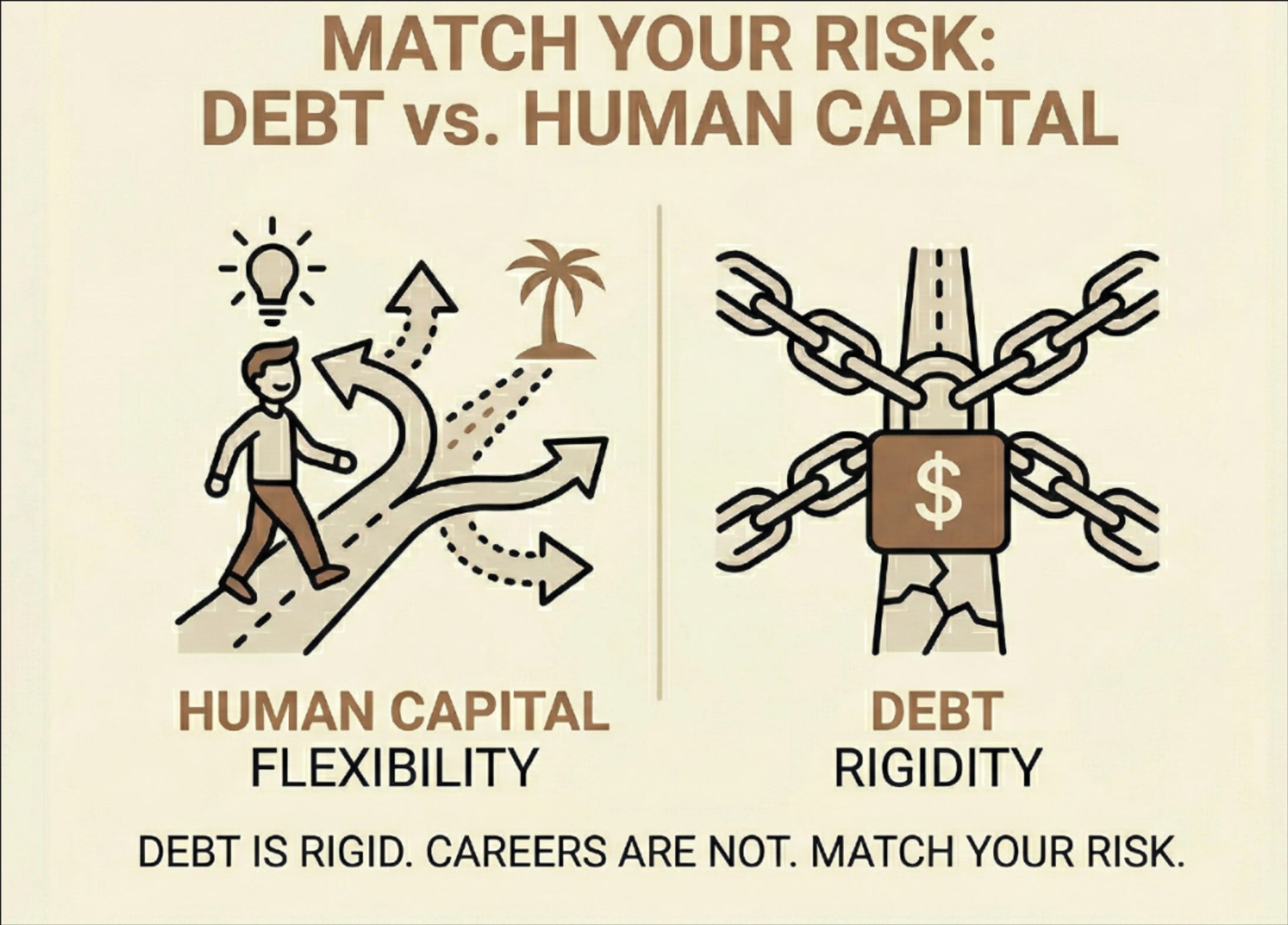
Human Capital: Your Largest, Least Diversified Asset
Human capital is the present value of your future earnings.
For most people, it represents:
70–90% of total lifetime wealth
A single income stream
Exposed to industry, geography, health, and timing risk
Unlike financial assets, human capital:
Cannot be rebalanced
Cannot be sold partially
Cannot be hedged easily
And yet, debt assumes it will behave smoothly.
Debt Assumes Stability Where None Exists
Debt contracts are rigid.
Human capital is not.
Debt implicitly assumes:
Continuous employability
Stable wages
Predictable career progression
But real careers look very different:
Non-linear paths
Voluntary and involuntary breaks
Sector-specific shocks
Skill obsolescence
Debt is priced as if income volatility were rare.
For individuals, it isn’t.
The Correlation Problem No One Talks About
The most underestimated risk is correlation between income and debt stress.
Income often drops when:
The economy slows
Markets decline
Credit conditions tighten
Exactly when:
Debt refinancing becomes harder
Asset values fall
Liquidity is most valuable
This is not bad luck.
It’s structural correlation.
Debt concentrates risk at the worst possible time.
Debt Turns Career Risk Into Financial Risk
Career risk is usually manageable:
You can switch roles
Change industries
Accept temporary income reductions
Debt removes that flexibility.
With debt:
Career experimentation becomes costly
Skill-building detours feel dangerous
Short-term income dominates long-term value
Debt pushes people to:
Stay in suboptimal jobs
Avoid entrepreneurial paths
Prioritize stability over growth
It quietly reshapes careers — often downward.
Why “Safe Jobs” Still Carry Debt Risk
Even traditionally stable professions face human capital risk:
Technological disruption
Regulatory changes
Health limitations
Burnout
Debt magnifies these risks by:
Increasing required income floors
Reducing tolerance for transitions
Penalizing recovery time
The problem isn’t job security.
It’s income rigidity paired with obligation rigidity.
The Asymmetry Between Debt and Human Capital
Human capital risk is asymmetric:
Downside is immediate
Recovery is slow
Timing matters more than averages
Debt ignores this asymmetry.
A short income disruption can:
Trigger forced asset sales
Destroy compounding
Permanently alter financial trajectories
This is why debt is often survivable — but career-damaging.
A More Honest Way to Evaluate Debt
Instead of asking:
“Can I afford the payments today?”
Ask:
“What happens if my income drops 30% for 12 months?”
If the answer involves:
Liquidating long-term assets
Abandoning strategic goals
Taking any job at any cost
Then the debt is misaligned with your human capital risk.
Matching Debt to Human Capital Quality
Debt is safest when human capital is:
Highly in-demand
Transferable across industries
Geographically flexible
Not tied to economic cycles
Debt is dangerous when human capital is:
Specialized
Cyclical
Location-dependent
Physically or mentally demanding
This is not about intelligence or effort.
It’s about risk matching.
Human Capital First, Balance Sheet Second
Most people optimize their balance sheet while ignoring their income statement.
This is backwards.
Before taking on debt, the priority should be:
Strengthening employability
Increasing income flexibility
Building optionality
Debt should come after resilience, not before it.
Final Thought
Debt assumes the future will cooperate.
Human capital proves it rarely does.
The real danger of debt is not default —
it’s locking your financial life to a single, fragile income trajectory.
When debt and human capital risk are misaligned,
even small shocks can cause permanent damage.
Design debt around uncertainty — not optimism.