

In the world of personal finance and investing, there are a million tips floating around: from “buy low, sell high” to “never touch your principal.” Yet despite good intentions, many investors end up committing the same predictable errors — not because they lack intelligence, but because they lack frameworks to avoid harm.
This post is not a collection of platitudes. It’s a practical, behavior-aware guide to the investment advice that’s actually useful — and the mistakes that quietly destroy long-term outcomes.
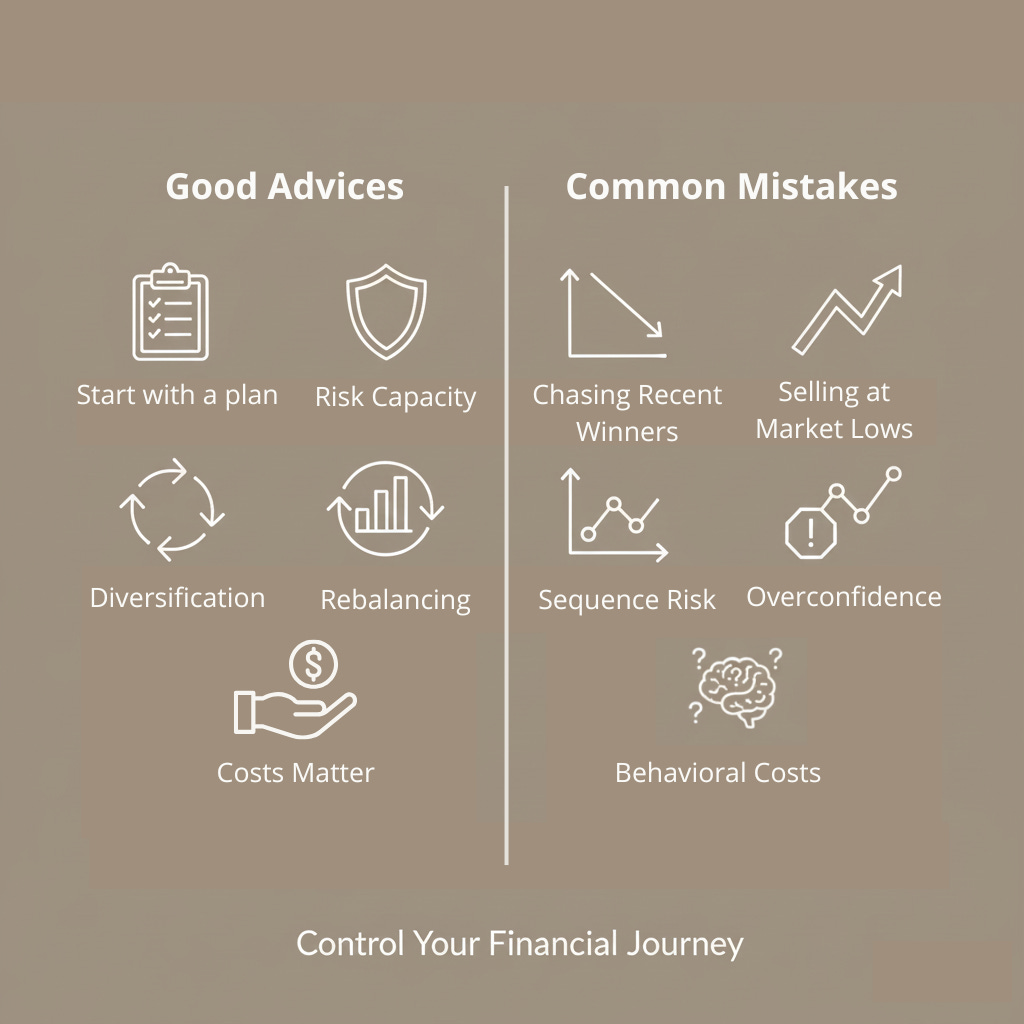
Advice That Matters (and Why)
Good investment advice isn’t universal. It depends on goals, time horizons, and personal risk tolerance. But some principles are robust because they reflect mechanics of markets, not opinions.
1. Start With a Plan, Not Predictions
Markets are unpredictable. Attempts to forecast short-term movements are nearly always fruitless because prices already reflect collective expectations.
Actionable guideline: Define your goals, risk tolerance, and investment process before allocating capital. A well-defined plan limits emotional deviations.
2. Decide on Risk Capacity, Not Risk Appetite
Risk appetite is subjective and unstable under pressure. Risk capacity — what you can objectively afford to risk — determines portfolio design.
Actionable guideline: Anchor your allocation to your financial realities (cash flow, emergency funds, time horizon), not how “brave” you feel.
3. Diversification Is Not Optional
Concentrated bets can lead to outsized returns — if they are backed by insight. For most investors, however, lack of diversification increases likelihood of catastrophic drawdowns.
Actionable guideline: Build portfolios that span asset classes and economic drivers to reduce dependence on any one outcome.
4. Rebalancing Is a Discipline, Not a Timing Tool
Rebalancing forces you to sell what has run up and buy what has lagged. It’s not about timing the market — it’s about enforcing discipline.
Actionable guideline: Rebalance based on rules (e.g., percentage bands or calendar intervals), not on forecasts.
5. Costs Matter — A Lot
Fees, taxes, and turnover erode returns over time. Small percentage differences seem insignificant until you look at compound effects.
Actionable guideline: Minimize avoidable expenses by preferring low-cost vehicles and tax-efficient structures.
Common Investment Errors — And How to Avoid Them
Knowing what not to do is sometimes more valuable than knowing what to do.
Mistake 1: Chasing Recent Winners
It’s tempting to pile into assets that recently outperformed. But past performance does not validate future performance.
Why it hurts: You buy after returns have already risen, reducing future expected returns and increasing downside if the trend reverses.
Better approach: Stick to your strategic allocation and rebalance into outperformers only when it aligns with your risk framework.
Mistake 2: Selling at Market Lows
Reacting to sharp declines by selling locks in losses. Markets often recover before news reflects the recovery.
Why it hurts: You sell when expected returns are highest and buy when they are lowest.
Better approach: Build buffers (emergency funds, proper horizon match) so you don’t need to liquidate during drawdowns.
Mistake 3: Ignoring Sequence Risk
Sequence of returns risk is the danger of experiencing negative returns early in retirement or near goal points.
Why it hurts: Even if long-term average returns are positive, negative early returns can deplete capital irreversibly.
Better approach: Use buckets or glide paths to protect near-term needs and preserve long-term growth.
Mistake 4: Overconfidence From One Good Prediction
Getting lucky once doesn’t imply skill. Overconfidence after a correct guess often leads to increased risk exposure without justification.
Why it hurts: You overweight your conviction based on anecdote, not structured evidence.
Better approach: Evaluate decisions based on process quality, not outcomes.
Mistake 5: Disregarding Behavioral Costs
Attention, stress, and emotional swings have opportunity costs. An “exciting” portfolio that keeps you awake at night is still a cost — even if returns look good on paper.
Why it hurts: Behavioral costs lead to premature selling, switching strategies, and increased trading.
Better approach: Design portfolios congruent with your psychology, not just theoretical returns.
The Most Underappreciated Part of Good Advice
Most investment advice focuses on what to do (e.g., buy this ETF). But the most important advice is about what to avoid and how to think:
Build Guardrails Before You Invest
Guardrails are rules that stop you from making irreversible mistakes:
Preset rebalancing triggers
Defined risk thresholds
Situations that trigger a review (not reactive moves)
Guardrails are not rigid barriers — they are decision filters that limit harm.
Replace Forecasting With Frameworks
Forecasting the economy or markets is a guessing game. Frameworks — like mean-variance allocation, risk budgeting, drawdown control — are tools. They don’t remove uncertainty, but they structure responses.
Focus on What You Can Control
Returns are uncertain; risk exposure, costs, diversification, and behavior are not.
Investors often obsess over returns because they are visible. But they should emphasize controllables, because those determine long-term outcomes.
Final Thought
Good investment advice is not a mantra repeated on social media.
Good investment advice is a set of repeatable, robust principles that help you navigate uncertainty without destroying your long-term goals.
Successful investing is not about being right about markets.
It’s about not being wrong about yourself.