

Why day trading is harder than it looks, and why long-term investing usually wins.
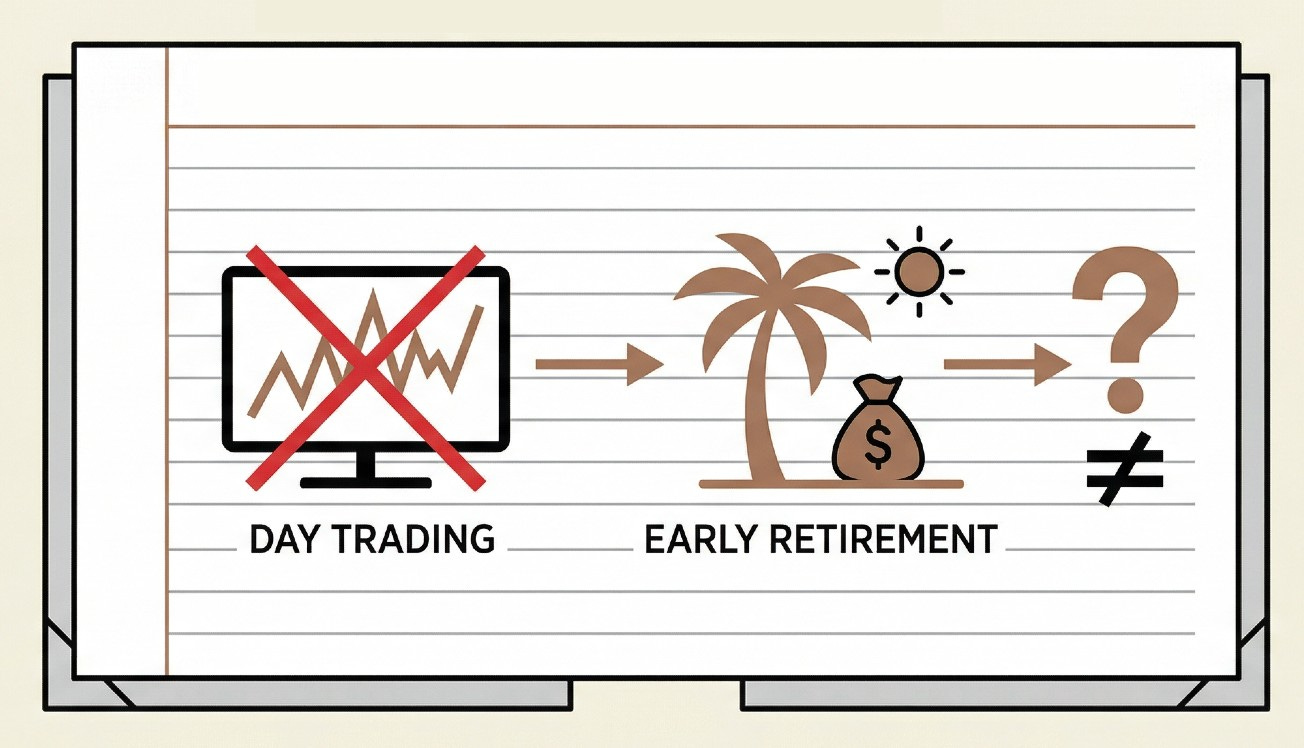
If you spend any time online, you’ve probably seen the ads: “Earn a living from your smartphone,” “Master this simple day-trading strategy,” or “Open an account today and get a welcome bonus.” The message is always the same. Accessing the financial markets is presented as simple, fast, and highly profitable. It seems like the ultimate shortcut to financial independence. But ask yourself: if someone had a foolproof, risk-free method to get rich, why would they spend money on ads to teach it to you instead of just using it themselves?
The truth is, making money with online trading is incredibly difficult. While long-term investing is like planting a tree and waiting for the fruit, day trading is like trying to guess the direction of a leaf in the wind. Let’s break down the reality of trading and why it’s often a losing game for retail investors.
The Reality of Retail Trading
Yes, it is mechanically possible to buy a stock and sell it a few hours later at a higher price. But the difficulty doesn’t lie in a single, isolated trade; it lies in generating consistent positive returns over a long time horizon.
Statistically, the picture is grim. It is estimated that 80% to 90% of amateur traders lose money within their first year. This isn’t due to individual bad luck; it’s a structural dynamic where the base of the pyramid pays for the apex. Here is why the odds are stacked against you.
1. You Are Competing Against Machines
When you place a trade from your laptop, you aren’t just competing against other humans. You are up against institutional algorithms and High-Frequency Trading (HFT) software.
These systems, managed by hedge funds and major banks, react to market news and execute trades in microseconds. Trying to beat them by clicking a mouse in your living room is like bringing a knife to a gunfight. In the short term, asset prices are driven by pure market “noise” — a sudden tweet, a news flash, or institutional order flows — making them nearly impossible for a retail trader to predict.
2. The Asymmetry of Losses (The Math Problem)
One of the most overlooked barriers in trading is how the math of losses works against your capital. In investing, losses affect your portfolio asymmetrically. Every time your capital drops, the percentage return required just to break even grows exponentially.
Consider this mathematical reality:
Lose 10%: You need an 11% gain to get back to zero.
Lose 50%: You need a 100% gain (doubling your money!) just to break even.
Lose 90%: You need a 900% gain to recover.
This is why a single bad streak—especially if you are using leverage (borrowed money)—can wipe you out entirely. Protecting your capital is paramount, but the high-risk nature of short-term trading makes this incredibly difficult.
3. The Psychological Toll
Even if you have a solid strategy, the psychological pressure of trading real money is immense. “Demo accounts” (paper trading) don’t prepare you for this. Losing virtual money lets you sleep at night; losing real money triggers intense emotional reactions.
When people see their rent or grocery money disappear, panic sets in. Fear causes traders to sell winners too early, while hope causes them to hold onto losers for too long. This emotional rollercoaster destroys discipline, leading to impulsive decisions and “revenge trading” to win back losses.
4. The Hidden Drain: Transaction Costs
Trading is not a zero-sum game; it is a negative-sum game. Every time you buy or sell, you pay a toll. Whether it’s direct commissions, bid-ask spreads, or taxes, the broker always takes a cut.
If you make 100 trades and break even against the market movements, you will still end up with a net loss due to the frictional costs of trading. Over time, these costs eat away at your capital.
Why Long-Term Investing Still Works
At A Wealthy Blog, the focus is on achieving financial independence through sustainable, long-term strategies. If you want to build wealth, the path isn’t through frantic daily transactions.
Here is how successful long-term investors approach the market differently:
Time-in-Market vs. Timing the Market: Instead of guessing short-term price movements, long-term investors capture the structural growth of the broader economy.
Compounding: By staying invested and reinvesting dividends, your wealth grows exponentially over decades.
Process Over Emotion: Utilizing strategies like Dollar-Cost Averaging (DCA) into broad index funds or ETFs removes the emotional stress of trying to pick the perfect entry and exit points.
Final Thought
Is making money with online trading a reality or a utopia? For a very small percentage of highly capitalized, experienced professionals, it’s a reality. For the vast majority of retail investors attracted by flashy marketing, it’s a costly utopia.
True wealth building is rarely fast and never flashy. It requires patience, discipline, and a focus on what you can control: your savings rate, your asset allocation, and your time horizon. Keep it simple, stay the course, and let the market do the heavy lifting for you.