

Every day the financial world is flooded with news:
central bank speeches, macroeconomic data, geopolitical events, corporate earnings surprises, political drama, viral social media threads.
Yet for most long‑term investors, this constant stream of updates is more noise than meaningful information.
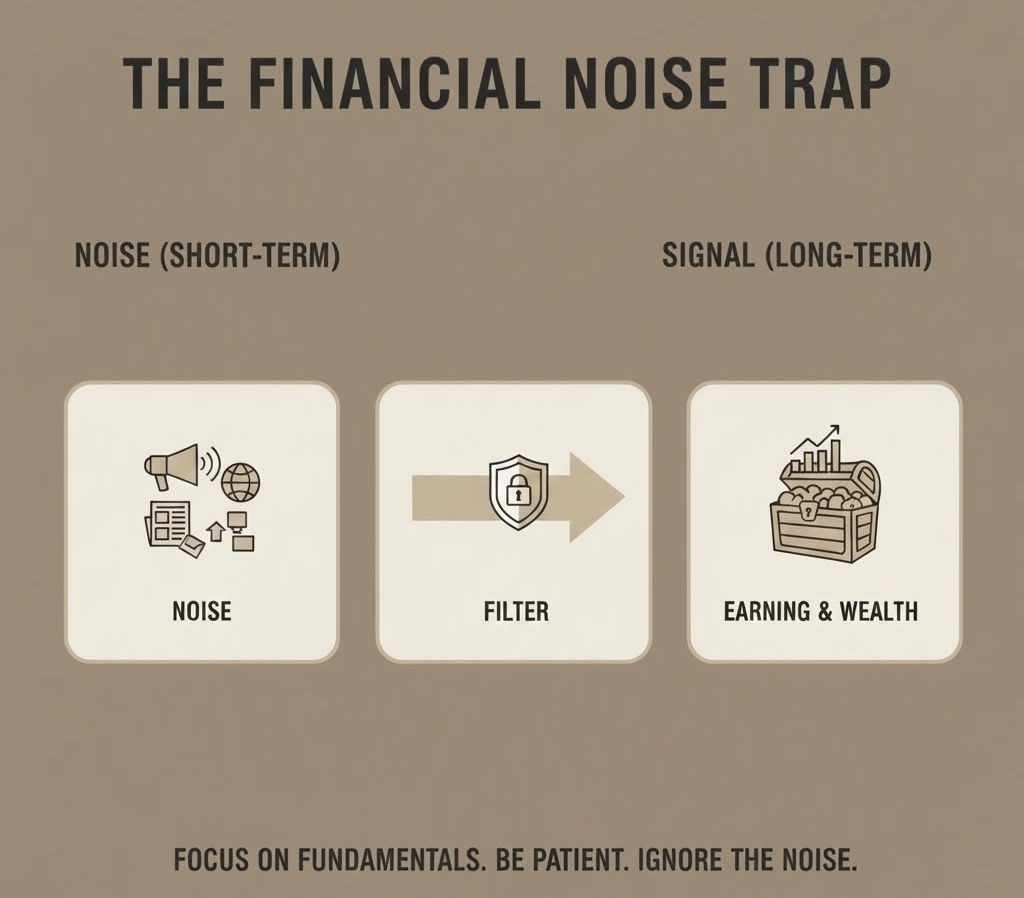
In fact, most short‑term financial news falls into a category known as noise — information that looks important but does not reliably predict future market outcomes.
This post explores why so much financial news is irrelevant for investors with a long‑term horizon, how it can mislead decision‑making, and what really matters for building wealth.
The Illusion of Insight: Why We Read Market News
Financial news attracts attention because it presents itself as actionable insight: forecasts of market direction, economic predictions, or interpretations of the latest central bank decision.
But here’s the catch:
Even expert analysts, armed with the same data and models, often produce diametrically opposed forecasts — and both are widely circulated as if one must be right.
That’s because short‑term predictions are extremely noisy. The underlying dynamics of markets — driven by countless interacting factors — make precise short‑term outcomes inherently unpredictable.
In statistical terms, what most financial news delivers is noise, not signal: low‑quality information that cannot reliably distinguish between meaningful trends and random variation.
Signal vs. Noise: A Useful Framework for Investors
In any information system, including financial markets, there are two components:
Signal: meaningful information that helps explain or predict outcomes
Noise: random or irrelevant information that obscures real insight
In a typical investing context, the signal‑to‑noise ratio is low — most immediate news is noise and not a dependable guide for future returns.
Investors who get caught up in this noise often:
Over‑react to minor events
Change allocation based on irrelevant data
Trade impulsively
All of which reduce long‑term returns and increase transaction costs and taxation.
Why Market Noise Is So Tempting
Despite being mostly irrelevant, short‑term financial news is persuasive for several reasons:
1. Availability Bias
Frequent headlines make recent events feel more important than they really are.
2. Narrative Fallacy
Humans prefer stories — especially dramatic ones — even when they add little predictive value.
3. Fear of Missing Out (FOMO)
When media and social commentary hype an opportunity or a risk, many investors feel compelled to act — often at the worst possible time.
These cognitive biases can turn harmless noise into behavioral risk, leading investors away from their long‑term strategies.
How Noise Affects Investment Behavior
Reacting to short‑term news can harm portfolios in several ways:
Frequent Trading
Acting on every headline leads to higher trading costs and often worse performance due to poor timing.
Risk Misallocation
Shifting between asset classes based on temporary fear or optimism disrupts strategic asset allocation.
Emotional Decision‑Making
News‑driven decisions are influenced more by mood than by rational assessment of fundamentals or objectives.
Behavioral finance shows that these kinds of errors are systematic and predictable — not random mistakes. This explains why many investors underperform the markets they invest in.
The Value of Ignoring Noise
Long‑term investing works best when it focuses on fundamentals, not headlines.
True drivers of long‑term returns include:
Earnings growth
Productivity increases
Demographic shifts
Technological progress
Capital accumulation
These factors evolve slowly and are barely reflected in day‑to‑day news, but they matter tremendously over years and decades.
Investors who ignore short‑term noise tend to:
Stay invested through volatility
Avoid unnecessary transaction costs
Benefit from compounding over time
A Simple Signal‑Focused Rule
Instead of reading every economic headline or forecast, ask yourself:
Does this change my evaluation of long‑term fundamentals?
If the answer is no, it’s likely noise.
A disciplined approach emphasizes process over prediction — making decisions based on strategic principles, not the latest market buzz.
Case in Point: When News Didn’t Matter
Looking back at market reactions to elections, central bank changes, or geopolitical tension, history shows that:
Markets often ignore, or quickly digest, short‑term shocks.
Long‑term trends prevail over headline‑driven movements.
Short‑lived fears rarely alter long‑term returns for diversified investors.
The noise dissipates; true investment performance remains tied to fundamentals and patience.
Final Thought: Noise Is a Distraction, Not Insight
Short‑term financial news feels urgent, but for the long‑term investor it is usually inconsequential. Markets are complex systems where random fluctuations outnumber meaningful signals in the short term.
Focusing on noise leads many investors away from their goals — chasing reactions instead of returns.
The right mindset is not to eliminate awareness of market events, but to calibrate their importance appropriately.
Investing is a long‑term discipline, not a real‑time guessing game.