

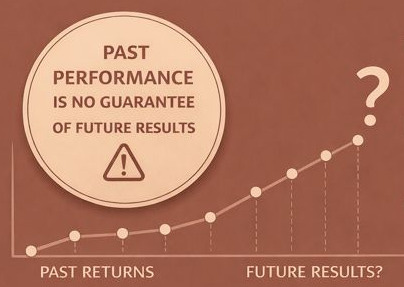
In investing, one of the most repeated cautions is: “Past performance is no guarantee of future results.” This disclaimer shows up everywhere — on fund factsheets, in broker communications, and in financial media — and for a good reason. Yet, at the same time, historical returns carry valuable information. The real question isn’t whether past performance predicts the future — it doesn’t — but how we should interpret and use historical data as a thoughtful investor.
Why Past Returns Don’t Predict the Future
Financial markets are complex, adaptive systems influenced by macroeconomics, policy decisions, innovation, technological change, demographics, and investor psychology. These factors are always shifting, meaning patterns that existed in one era may not hold in another.
For example:
A stock market that rallied through a decade of low interest rates might behave differently when rates rise significantly.
A sector like technology that dominated returns over a specific period may face headwinds as valuations expand or competition intensifies.
Because conditions change, relying solely on historical returns as a predictor of future performance is risky and often misleading.
Why Past Returns Still Matter
If past returns don’t predict the future, why do we bother looking at them at all? Because they tell us something important about risk and reward relationships, volatility, and the historical behavior of asset classes — not as exact forecasts, but as contextual benchmarks.
Here’s what historical performance can teach us:
1. Expected Risk-Return Tradeoff
Historical data shows that certain asset classes — like equities — have rewarded investors with higher long-term returns compared to bonds or cash. At the same time, stocks have historically been more volatile. Although future returns can deviate from history, this risk-return relationship helps inform strategic allocation decisions.
2. Volatility Patterns
By studying past returns, investors gain insight into how different assets behave through cycles — expansions, recessions, inflationary periods, and crises. This doesn’t offer precise predictions, but it reveals the range of possibilities and helps build realistic expectations.
3. Frameworks, Not Forecasts
Historical returns support the why of investing frameworks like diversification and long-term orientation. They don’t guarantee that markets will repeat, but they show the value of patience — how compounding and staying invested through downturns have benefited disciplined investors in the past.
Common Misuses of Past Returns
While historical data is informative, certain interpretations can mislead even experienced investors:
1. “Hot Hand” Fallacy
Assuming that because an asset or fund performed exceptionally well recently, it will continue to do so. This is a behavioral bias that often leads to buying high and selling low, the opposite of disciplined investing.
2. Chasing Top Performers
Investors sometimes shift capital toward recently strong performers — only to find that when sentiment shifts, those same assets lag. Historical winners can become future laggards, especially when valuations become stretched.
3. Ignoring Structural Change
Past returns reflect specific economic regimes. A strategy that thrived during low inflation and low rates might struggle in a high-inflation, rising-rate environment. Using history without understanding why those returns occurred can be dangerous.
A Better Way to Use Historical Returns
Here are disciplined ways to integrate past performance into investment thinking:
Use History as a Reference, Not a Forecast
Think of historical returns as a descriptive tool, not a predictive one. They help you understand how asset classes have behaved across environments, not how they will behave tomorrow.
Contextualize Returns with Risk Metrics
Absolute returns are only part of the story. Pair them with risk measures — like volatility, drawdowns, and Sharpe ratios — to understand what kind of risk was taken to achieve those results. A strategy that made 15% annually but with massive drawdowns might not suit everyone.
Focus on Process, Not Outcomes
Superior investment outcomes are rooted in disciplined processes — diversification, rebalancing, consistent contributions, and staying the course. Past returns are outcomes; your process is what you control.
Why Long-Term Investing Still Works
Despite the unpredictability of short-term returns, markets over long horizons have tended to rise. This doesn’t mean future cycles will replicate past ones, but it highlights two key principles:
Compounding: Reinvesting returns builds on itself over time.
Time-in-Market Beats Timing the Market: Trying to jump in and out based on predictions has historically underperformed simply staying invested.
These observations aren’t guarantees — they’re probabilistic tendencies grounded in decades of market behavior. They inform strategy, not forecasts.
Practical Takeaways for Investors
1. Don’t build expectations solely on past returns.
Treat historical data as context, not a prediction.
2. Balance return data with risk insight.
Ask: How much volatility did it take to achieve those returns?
3. Align strategy with goals and horizon.
Your personal time horizon and financial needs should guide how you interpret historical behavior.
4. Resist chasing performance.
Chasing recent winners often leads to selling at the wrong time.
5. Embrace discipline over prediction.
A consistent, rules-based approach — diversification, rebalancing, systematic contributions — generally outperforms attempts to forecast the future.
Final Thought
History doesn’t repeat perfectly, but it rhymes. Past returns provide a narrative, not a script. They help you understand what has happened under various conditions, but they should never be mistaken for a crystal ball.
Wise investors use historical performance as a compass, not a map — guiding broad direction while recognizing that the terrain ahead may look very different.