

Market crashes don’t just test portfolios.
They test investors.
And historically, most damage during crashes is not caused by markets themselves, but by investor behavior: panic selling, timing errors, emotional decisions made under stress.
This article is not about staying calm or believing blindly in the long term.
It is about building a behavioral survival kit — a framework designed to prevent irreversible mistakes when markets stop behaving normally.
Panic Selling: Why It Feels Rational (and Isn’t)
During a crash, selling feels logical. Prices fall fast, uncertainty explodes, and fear activates the brain’s survival mode.
The problem is that panic selling usually occurs after most of the decline has already happened.
Crashes are asymmetric:
Fast and violent on the way down
Gradual and unpredictable on the way up
Selling in panic locks in losses and requires two perfect decisions to recover: selling near the bottom and re-entering before the rebound. Most investors fail at both.
Panic selling is not risk management.
It is risk crystallization.
Survival rule: if the investment thesis hasn’t changed, price alone is not a reason to sell.
Timing Errors: The Silent Destroyers
Timing errors don’t feel dramatic, but they quietly erode long-term outcomes.
They usually appear as:
Waiting for clarity while markets recover in silence
Re-entering too late because fear remains after prices rise
Gaining false confidence after one correct timing decision
Markets do not reward hesitation. They punish indecision disguised as prudence.
Survival rule: any strategy that requires precise timing is fragile by design.
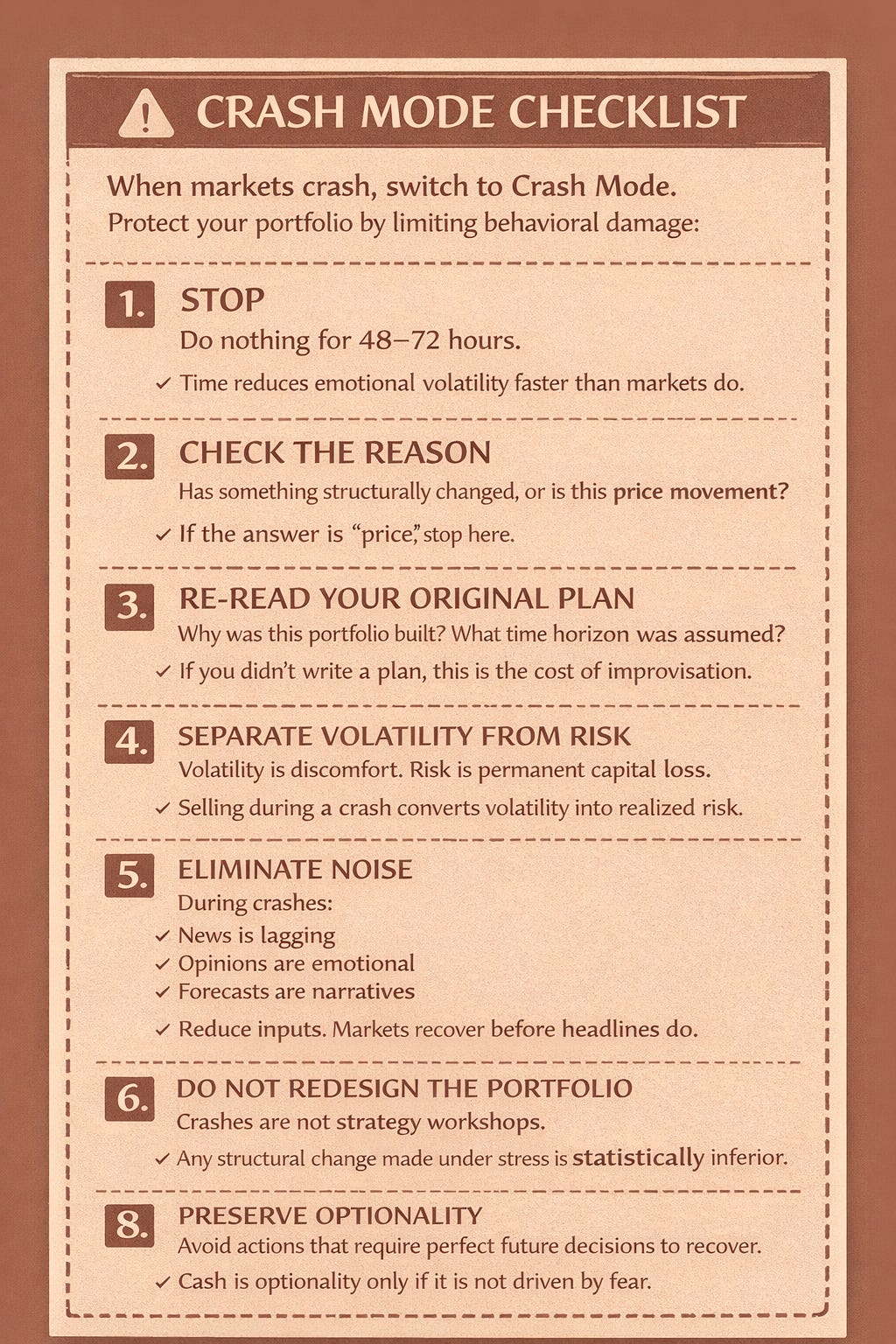
Crash Mode Checklist (Read Before Doing Anything)
When markets crash, switch to Crash Mode.
This checklist is not about optimizing — it’s about damage control.
1. Stop
Do nothing for 48–72 hours.
No trades, no reallocations, no “small adjustments.”
Time reduces emotional volatility faster than markets do.
2. Check the reason
Ask a single question:
Has something structurally changed, or is this price movement?
If the answer is “price,” stop here.
3. Re-read your original plan
Why was this portfolio built?
What time horizon was assumed?
What risks were explicitly accepted?
If you didn’t write a plan, this is the cost of improvisation.
4. Separate volatility from risk
Volatility is discomfort.
Risk is permanent capital loss.
Selling during a crash converts volatility into realized risk.
5. Eliminate noise
During crashes:
News is lagging
Opinions are emotional
Forecasts are narratives
Reduce inputs. Markets recover before headlines do.
6. Do not redesign the portfolio
Crashes are not strategy workshops.
Any structural change made under stress is statistically inferior.
7. Preserve optionality
Avoid actions that require perfect future decisions to recover.
Cash is optionality only if it is not driven by fear.
8. If in doubt, default to inaction
In investing, doing nothing is often an active decision — and frequently the correct one.
What Not to Do During Market Crashes
Some behaviors consistently destroy value:
Chasing “safety” after losses
Switching strategies mid-crisis
Anchoring to previous market highs
Equating market drops with economic collapse
Consuming financial media as decision support
Crashes create the illusion that action equals control.
In reality, restraint is often the highest form of control.
The Real Objective During a Crash: Survival
The goal during a crash is not to be clever.
It is to avoid irreversible mistakes.
Markets recover.
Time compounds.
Behavioral errors don’t self-correct.
Survival means:
Staying invested if the plan remains valid
Avoiding forced decisions
Accepting emotional discomfort without acting on it
You don’t need conviction.
You need consistency.
Final Thought: Crashes Are Behavioral Filters
Market crashes don’t reward prediction or bravery.
They reward process.
They filter out investors who confuse movement with meaning, and discipline with passivity.
Long-term results are not built in moments of panic —
they are preserved by avoiding catastrophic errors when emotions are loudest.
The best investors are not the ones who act best during crashes, but the ones who do the least damage.