

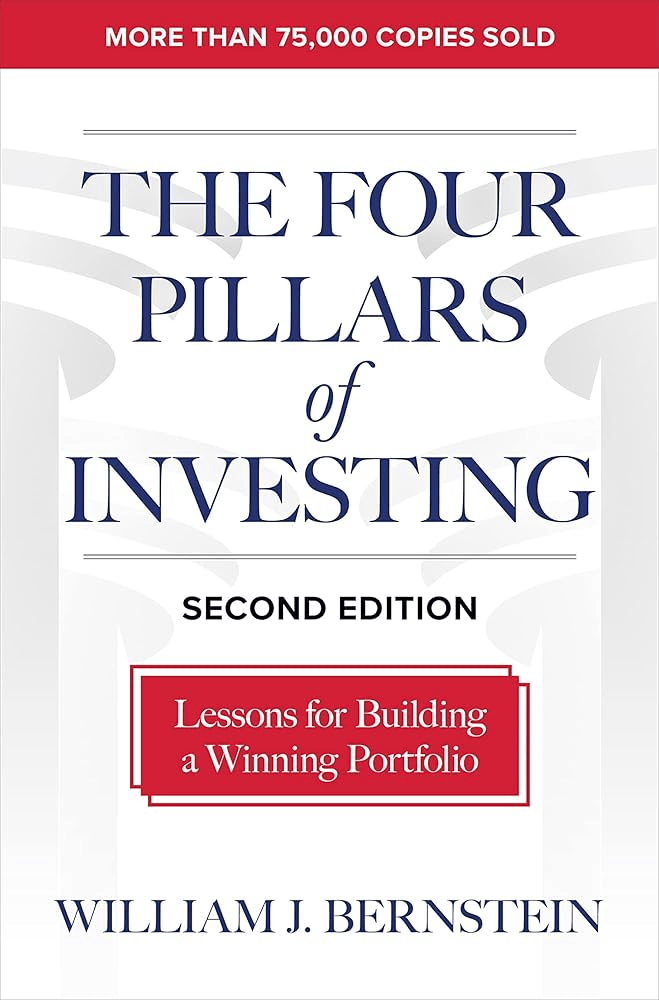
The Four Pillars of Investing by William J. Bernstein is not a book about beating the market.
It is a book about understanding how markets actually work, why investors fail, and how to build a process that survives reality.
Much like The Simple Path to Wealth, this book strips investing down to its essentials — but it does so with more depth, more history, and a sharper focus on behavior and incentives.
If The Simple Path to Wealth tells you what to do, The Four Pillars of Investing explains why it works — and why so many people still fail to follow it.
What the Book Is Really About
Bernstein’s core idea is straightforward:
Successful investing is not about intelligence, forecasts, or complexity.
It is about understanding a small set of fundamental truths — and not violating them under pressure.
The book is structured around four “pillars,” each addressing a different source of investor failure. Together, they form a complete investing framework.
Pillar 1 — Investment Theory: How Returns Are Actually Generated
This pillar establishes the intellectual foundation.
Key ideas:
Risk and return are inseparable
Higher expected returns require higher volatility
Asset allocation matters far more than security selection
Markets are hard to beat consistently
Bernstein makes a crucial point: most investors take risk without being compensated for it, often by concentrating portfolios, chasing trends, or overtrading.
The takeaway is not to eliminate risk — but to take only the risks that have historically been rewarded, and to do so systematically.
Pillar 2 — Investment History: Why “This Time Is Different” Never Is
History is not presented as a forecasting tool, but as an antidote to narrative thinking.
Through bubbles, crashes, wars, inflationary regimes, and technological revolutions, Bernstein shows that:
Markets repeatedly overshoot in both directions
Innovation does not guarantee investor returns
Extreme events are normal, not rare
Understanding history doesn’t prevent losses — but it prevents panic.
It teaches investors that drawdowns are a feature, not a bug.
Pillar 3 — Investment Psychology: The Real Enemy
This is the most important pillar.
Bernstein argues that most investors do not fail because of bad strategies, but because of poor behavior under stress.
Common failures include:
Panic selling during crashes
Chasing recent performance
Overconfidence after short-term success
Abandoning sound plans at the worst moment
The uncomfortable truth is that knowing the right strategy is easy; sticking to it is hard.
Good investing, according to Bernstein, is largely about designing systems that minimize the need for willpower.
Pillar 4 — The Investment Business: Understanding Incentives
The final pillar exposes the reality of the financial industry.
Key insights:
The investment industry is designed to extract fees, not maximize your returns
Complexity often benefits providers, not investors
Costs, taxes, and turnover quietly destroy compounding
Bernstein encourages investors to be skeptical consumers:
Favor low-cost, transparent instruments
Avoid unnecessary intermediaries
Ignore most financial media
The message is clear: no one cares more about your money than you do.
How This Book Changes the Way You Invest
After reading The Four Pillars of Investing, several conclusions become hard to ignore:
Simplicity is a strength, not a compromise
Diversification is risk control, not return maximization
Discipline beats intelligence
Costs matter more than forecasts
Behavior determines outcomes
This book doesn’t make investing exciting.
It makes it robust.
Who This Book Is For
This book is ideal for investors who:
Want to understand investing, not just follow rules
Are skeptical of market predictions and “expert” advice
Care about long-term outcomes over short-term excitement
Want a framework that holds up during crashes
It is not for those looking for shortcuts or market timing strategies.
Final Takeaway
The Four Pillars of Investing delivers a quiet but powerful message:
The hardest part of investing is not finding the right assets.
It is building a structure — intellectual, emotional, and practical — that prevents self-destruction.
Much like The Simple Path to Wealth, this book ultimately argues for humility, patience, and consistency. But it adds something essential: an understanding of why these principles are so often violated.
If you want to invest not just efficiently, but sustainably, this book belongs on your shelf.